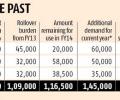
For 2014-15, the bill on this account is likely to be 12.8% more than in 2013-14.

Here are the key numbers to watch out for in the Budget for 2022-23, which is widely expected to boost spending towards policies that create jobs, boost manufacturing, helping rural and agri-economy and infrastructure creation. Sitharaman, who had in her first budget in 2019 replaced leather briefcase -- which had been in use for decades for carrying budget documents -- with a traditional red cloth 'bahi-khata', has spurt in tax collections to her aid in the budget that is expected to a spend-all budget.

India will be the world's third-largest economy by 2028 as it becomes the world's most sought-after consumer market and gains share in global output, driven by macro stability influenced policy and better infrastructure, Morgan Stanley said. From a $3.5 trillion economy in 2023, the Indian economy is projected to expand to $4.7 trillion in 2026, which will make it the fourth largest in the world behind the US, China and Germany.

'If such inflows materialise, what will be the effect on the rupee's value -- and therefore on exports growth, the only sustainable path to recovery?', asks Mihir S Sharma.


The interim Budget proposals that will be presented on February 1 in the backdrop of the general elections scheduled in April/May 2024 are likely to have a hint of populism, believe analysts, but are unlikely to derail the government from its path of fiscal prudence.

Lower revenue collection puts upward pressure on government borrowing, ensuring that it deviates from the glided path of debt reduction

Gold prices could hit the $3500 an ounce (oz) mark in the next 18 months - up around 13 per cent from the current levels - given the global uncertainties and aided by investment demand, said analysts at BofA Securities in a recent note. Uncertainty around Trump Administration trade policies, BofA said, could continue to push the US dollar (USD) lower, further supporting gold prices near-term.

The rating agency, however, pointed out that India's fiscal position remains precarious, with elevated fiscal deficits and net government indebtedness.

Chidambaram's comments come in the backdrop of lukewarm response to the 2G spectrum auction which could fetch the government only Rs 9,407 crore (Rs 94.07 billion) as against the target of Rs 40,000 crore (Rs 400 billion).
Finance Minister Pranab Mukherjee on Tuesday sought to soothe industry's and stock market's nerves by saying that the government would not monetise the fiscal deficit. Spending a good part of his reply in the Lok Sabha on allaying fears over the seeming lack of reforms in his July 6 Budget, Mukherjee promised a roadmap for disinvestment in public sector undertakings and the financial sector.

Warning that the new year will be riskier than the previous two in terms of growth, inflation and the perils of monetary policy normalisation on consumption demand in particular, along with other external risks, a Wall Street brokerage has pencilled in an 8.2 per cent GDP growth next fiscal, with more downside risks to the projection. The biggest risk to the projection is a derailed consumption demand that has been the main growth driver in the past many years, said the Bank of America Securities India house economists who still believe that consumption demand will remain the key driver of growth next fiscal as well.
Chief Economic Adviser K V Subramanian on Wednesday said India is expected to hit a growth rate of 6.5-7 per cent in 2022-23 and accelerate further to 8 per cent in the subsequent years on the back of reforms undertaken by the government. He also said the government is expected to meet the fiscal deficit target of 6.8 per cent in the current fiscal despite pressure on revenue collections.
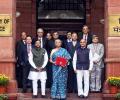
Finance Minister Nirmala Sitharaman on Thursday presented her sixth Budget in a row, equalling the record of former Prime Minister Morarji Desai.

The Indian rupee is likely to depreciate further against the US dollar through the end of 2024. This is due to the continued strengthening of the greenback, combined with the weakening of the Chinese yuan, which is expected to keep pressure on the Indian currency.
The 3G mobile licence bonanza is expected to generate over Rs 40,000 crore for the central exchequer this year, as a result of which the fiscal deficit may stand at 1.75 per cent of GDP in 2008-09, lower than the 2.5 per cent projected in the Budget. "The important thing, from a public finance perspective, is to remember that this is a one-time inflow and we should treat it as such," said Finance Secretary Subbarao.

Moody's Investors Service, while silent on the sovereign rating on the higher-than-expected fiscal deficit numbers, expressed doubts over attaining the higher revenue targets and divestment realisation as assumed in the Budget. The Union Budget 2021-22 has pegged a fiscal deficit of 9.5 per cent for the current financial year as against the consensus 7 per cent, and 6.8 per cent for 2021-22 with a market borrowing of around Rs 12 lakh crore. It also assumes Rs 1.75 lakh crore to be scooped up from divestment.

Fresh plans of privatisation or divestment in central public sector enterprises and public sector banks might take a back seat this financial year because these may require a large consensus among coalition partners.

Kaushik Basu, chief economic advisor in the finance ministry, said, "All I can say is, we are very serious about fiscal consolidation, and intend holding on to our fiscal targets, even if the crude price rises on a sustained basis."

Do the actual numbers bear out the claims made by the government or do they suggest something else? asks A K Bhattacharya.

Benchmark stock indices Sensex and Nifty rallied more than 1.6 per cent to close at lifetime high levels on Thursday following buying in banking, oil and auto shares and a record dividend payout by the RBI to the government. Regaining the 75,000 level after its best single-day gain since January 29, the 30-share BSE Sensex closed at all-time peak of 75,418.04, up by 1,196.98 points or 1.61 per cent over the last close.

Former prime minister Manmohan Singh said India is poised to take advantage of globalisation and engage in trade to finance its imports through exports.

Exports of petroleum products, chemicals, pharmaceuticals, gems and jewellery, and engineering goods registered a positive growth.

'But can it afford to present a scenario within the existing legal framework of fiscal consolidation?', asks A K Bhattacharya.

'The problem is that the bubble may not only be in valuations, but also in investors' minds.'
The International Monetary Fund forecast on Thursday that the Indian economy will grow 5.5 per cent in 2003-04 with some upside potential, but said fiscal deficit and public debt were an economic burden.

The new pay scale will come into effect from January 1.

The recent stimulus measures announced by China have seen most analysts sit up and take notice.

The government has at last commenced important structural reforms.

Pranab Mukherjee will have to stay lucky if he is to climb the big mountain that lies ahead.

Fitch frowns at government pay hikes.

Alloting more funds for MNREGA and PM-KISAN could wipe out the entire additional money that the Centre may have for FY25.

The Union government's finances witnessed significant improvement in August after a stressful first four months of the current fiscal year. India's gross tax revenue, comprising both direct and indirect taxes, for the first five months of 2023-24 surged 16.5 per cent year-on-year (Y-o-Y) to Rs 11.8 trillion. During the April-July period, gross tax revenue increased by a mere 2.8 per cent compared to the Budget Estimate of 12.1 per cent growth for FY24.

India's current account deficit narrowed to $1.3 billion or 0.2 per cent of GDP in the January-March quarter of FY23, mainly due to moderation in the trade deficit and a robust increase in services exports, RBI data showed on Tuesday. However, for the 2022-23 fiscal, the current account balance recorded a deficit of 2 per cent of GDP compared to 1.2 per cent in 2021-22. "India's current account deficit (CAD) decreased to $1.3 billion (0.2 per cent of GDP) in Q4:2022-23 from $16.8 billion (2.0 per cent of GDP) in Q3:2022-231, and $13.4 billion (1.6 per cent of GDP) a year ago [Q4:2021-22]," as per the RBI's 'Developments in India's Balance of Payments during the Fourth Quarter (January-March) of 2022-23'.

The finance minister has stayed true to her commitment to fiscal consolidation, even though the pace of the decline in the deficit could have been faster, notes A K Bhattacharya.
India will find it tough to meet its fiscal deficit target for the new year starting in April, given its plans to cut taxes and step up spending on infrastructure, Moody's Investors Service said.

The government's move to freely supply coronavirus vaccines to the states for universal inoculation and extend free rations to help the poor tide over the pandemic will only add an additional 40 bps of GDP to fiscal deficit, says a report, which also called for more transparent vaccine distribution plan for efficient vaccine allocation to the states.
Former Union Finance Minister P Chidambaram on Friday said the Union Budget had been drafted in anticipation of early general elections and the fiscal deficit would move up to 6.2 to 6.3 per cent as against the 5.9 per cent projected in the Budget.

The finance ministry will kick-start the exercise to prepare the Union Budget for financial year 2022-23 (FY23) from October 12, according to an official notification released on Monday. "The pre-Budget meetings as well as the meetings to discuss the revised estimates will start from October 12 and will continue till the second week of November," according to the Budget circular of the Department of Economic Affairs' Budget Division. The Union Budget is expected to be announced on February 1, as has been the practice of the past few years.

They pointed out that Finance Minister Nirmala Sitharaman relies a lot on divestments, where the government under-performed in FY2019-20, to achieve the 3.8 per cent fiscal deficit target.
